

Memory
How Brain builds up institutional knowledge of your practice — so every conversation starts from where the last one left off.
Every time you have a conversation with Brain, something more is happening than answering a question. Brain is building a picture of your practice — your niche, your audience, your existing products, your methodology, the strategic constraints you work within — and saving it so the next conversation starts from a more informed position.
This is Brain's memory system. And it means that over time, Brain becomes something more than a strategy tool you query. It becomes a strategic advisor that genuinely knows your business.
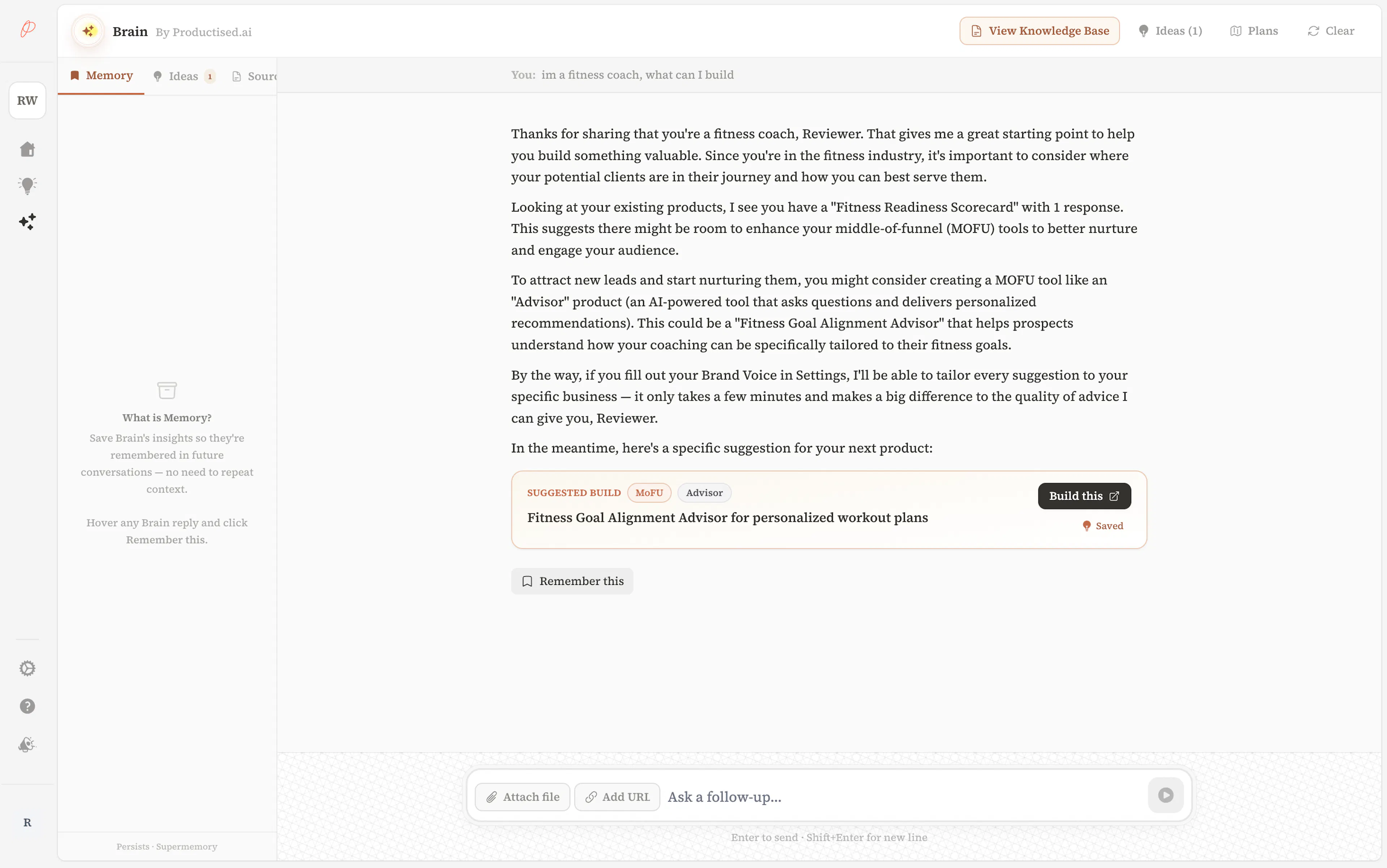
What Brain remembers
Brain automatically extracts and saves key facts from your conversations. The kinds of things that matter for a coaching or consulting practice:
-
Your target audience — who specifically you work with, at what level, in which sector
-
Your positioning and differentiation — what makes your approach distinct from other practitioners in your niche
-
The products you've built or discussed with Brain — what already exists in your funnel
-
Your proprietary frameworks and methodology — how you think about the problems you solve
-
Strategic goals you've mentioned — growth targets, audience expansion, offer development
-
Constraints and preferences — "I don't want to add more complexity to my funnel right now," "I'm moving upmarket and don't want to attract price-sensitive buyers"
-
Funnel gaps and opportunities that emerged in past conversations
You don't configure any of this. Brain extracts what matters and saves it in the background.
How memories shape future conversations
Saved memories don't just sit there — they're actively used to personalise every subsequent conversation.
If you told Brain that you work exclusively with executive coaches who charge above £10k for their signature programme, Brain will not suggest a high-volume ToFU quiz designed to attract early-stage coaches. It already knows that audience doesn't fit.
If you spent a session working through your proprietary four-step diagnostic framework, Brain will refer to that framework when recommending products — suggesting ways to productise each step, or identifying which step would make the strongest standalone lead magnet.
If you established three months ago that you're cautious about adding complexity to your back-end systems, Brain will lean toward simpler products when making new recommendations, even in new conversations where you haven't restated that preference.
The practical effect: your conversations get sharper and more precise over time. The more you use Brain, the more it functions as an advisor who genuinely knows your practice rather than one you have to brief from scratch every session.
The Memories tab
The left panel in Brain includes a Memories tab showing the context Brain has saved from your conversations. Each entry shows the fact or insight Brain captured, and when.
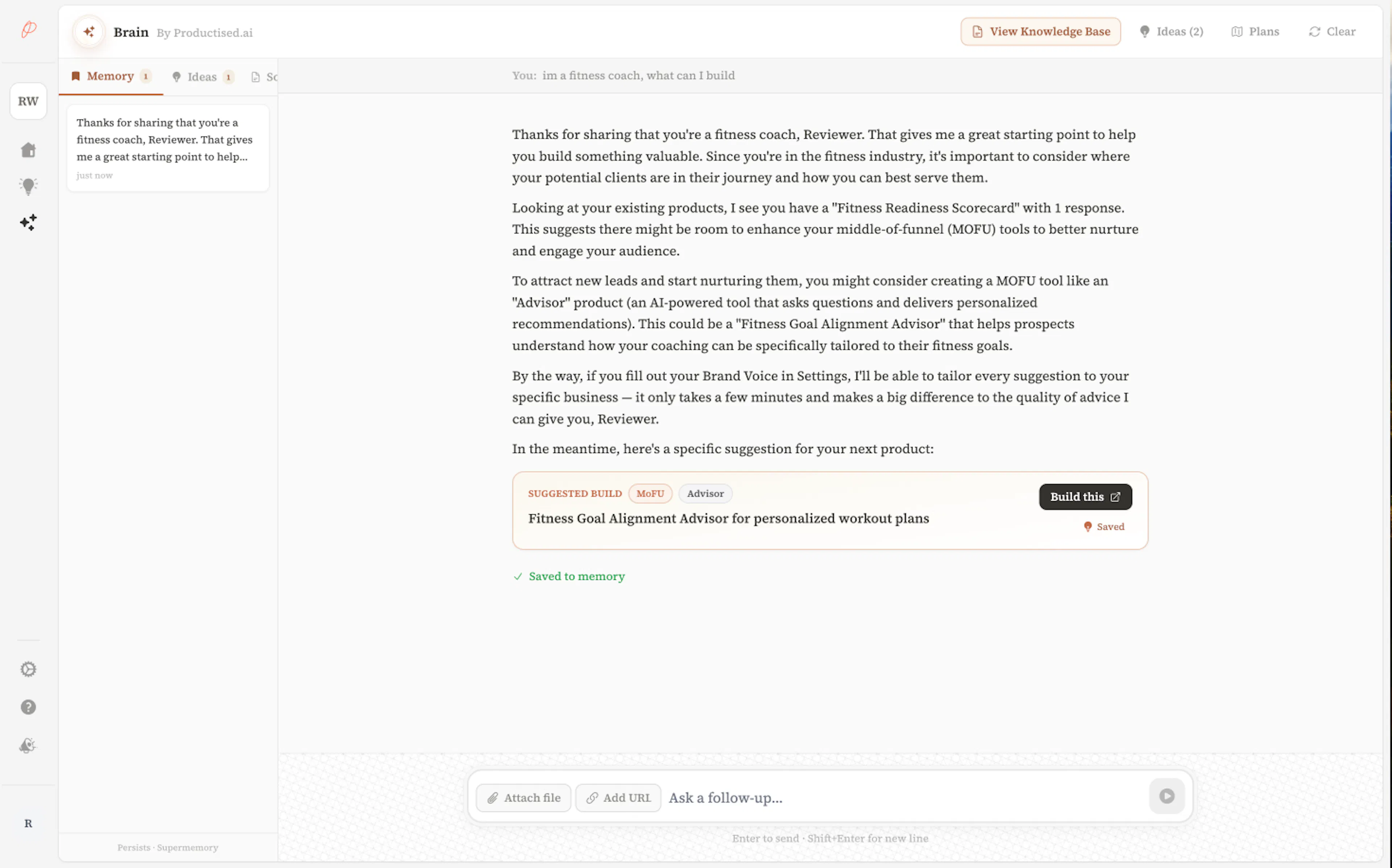
If a memory is out of date — you've pivoted your niche, your target client profile has changed, a product you were considering is no longer relevant — you can delete it. Brain will stop using that context in future conversations and adapt to what's currently true.
Memories are there to serve your business, not to lock it in. If something Brain saved no longer reflects your positioning or direction, delete it and correct Brain in your next conversation. It adapts.
Memories are workspace-wide
Memories belong to your workspace, not to a single user. Everyone on your team benefits from the same accumulated context. If a collaborator has had conversations with Brain that established useful context about your audience or positioning, that context is available in your conversations too.
This is particularly useful for practices where different team members handle different aspects of strategy. Brain maintains a coherent, unified picture of the workspace — your positioning, your methodology, your funnel — regardless of who built up that context over time.
How memory retrieval works
Brain uses vector search to match memories to your current conversation. When you ask a question, Brain doesn't load every saved memory into the conversation — it finds the most semantically relevant ones, based on what you're actually discussing, and surfaces only those.
The result is context that feels natural rather than overwhelming. Brain brings in what's relevant without flooding the conversation with information that doesn't apply to the current question.
Building institutional knowledge with Sources
Memories are one half of Brain's long-term context. The other is your Sources — documents and URLs you upload deliberately to give Brain structured knowledge of your practice.
Memories are automatic and conversational. Sources are intentional and document-based. Together they form the institutional knowledge base that makes Brain's advice specific to you, not generic.